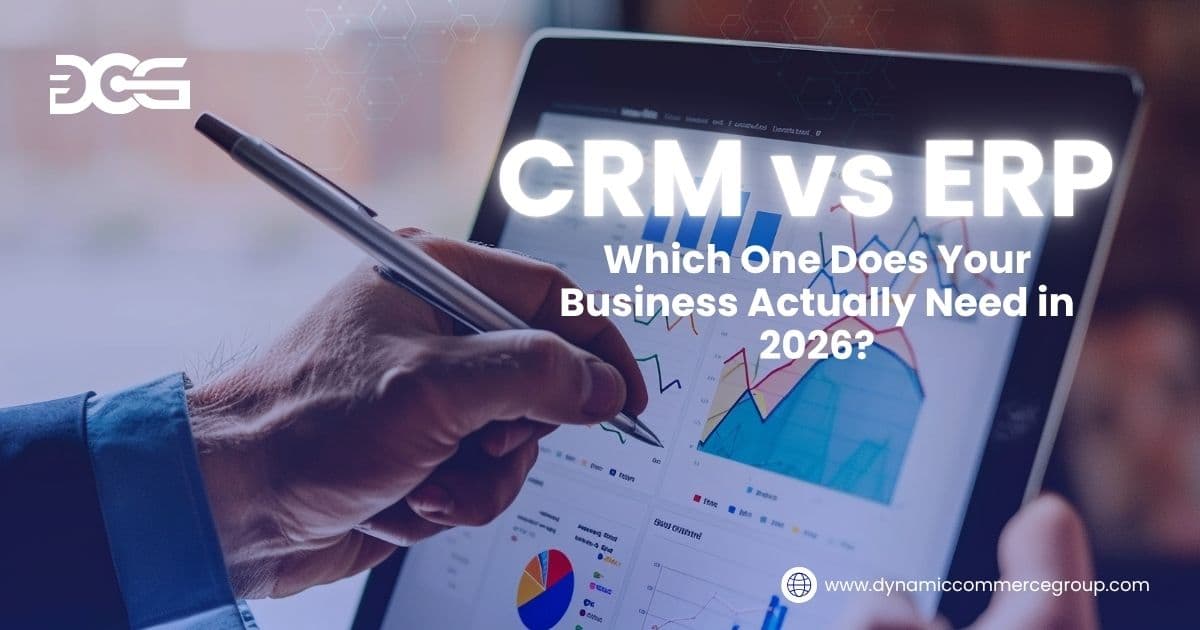
CRM vs ERP: Which One Does Your Business Actually Need in 2026?
CRM vs ERP Secondary keywords: difference between CRM and ERP, CRM ERP for small business, AI CRM ERP platform, business management software
Introduction
If you have ever searched for business software, you have almost certainly hit two acronyms that get thrown around as if they mean the same thing: CRM and ERP. They do not. Choosing the wrong one — or buying both before you are ready — is one of the most expensive mistakes a growing company can make.
This guide breaks down the real difference between CRM and ERP, shows you exactly when each one earns its place in your business, and explains why the newest AI-powered platforms are quietly erasing the line between them.
What Is a CRM?
CRM stands for Customer Relationship Management. At its core, a CRM is the system that manages everything that happens before and around a sale — and everything that keeps a customer coming back.
A good CRM tracks leads, contacts, deals, conversations, follow-ups, and the full history of every relationship your business has. It answers questions like: Who is in our pipeline? Which deals are about to close? Which customer has not heard from us in 90 days?
CRM is fundamentally about revenue and relationships. If your biggest pain is that leads slip through the cracks, sales reps forget to follow up, or you have no idea what is really in your pipeline, a CRM is where you start.
What Is an ERP?
ERP stands for Enterprise Resource Planning. Where a CRM looks outward at customers, an ERP looks inward at operations.
An ERP is the central nervous system for the parts of the business that keep the lights on: inventory, purchasing, accounting, invoicing, order fulfillment, HR, and reporting. Instead of a dozen disconnected spreadsheets and tools, everything runs on one shared database, so a sale in one department automatically updates stock, finance, and shipping.
ERP is fundamentally about efficiency and control. If your pain is that inventory numbers never match, finance lives in one tool and operations in another, or you cannot get a single trustworthy report across the company, an ERP is the answer.
CRM vs ERP: The Core Difference in One Line
Here is the simplest way to remember it:
A CRM helps you win and keep customers. An ERP helps you run the business behind those customers.
CRM is your growth engine. ERP is your operating backbone. Most companies feel the CRM pain first — because sales and marketing problems show up in the bank account fast — and the ERP pain later, as complexity grows.
When Do You Need a CRM?
You likely need a CRM if:
Leads and follow-ups are managed in spreadsheets, notebooks, or someone's memory. You cannot answer "what is in our pipeline right now?" in under a minute. Sales handoffs between people are messy and things get dropped. You have no reliable record of past conversations with a customer. Marketing and sales are not working from the same list.
If two or more of these sound familiar, CRM is your priority — regardless of company size.
When Do You Need an ERP?
You likely need an ERP if:
You manage physical or digital inventory across multiple channels or locations. Your accounting, purchasing, and operations data lives in separate tools that do not talk to each other. Manual data entry between systems eats hours every week. You cannot produce a single accurate report across finance, stock, and sales. You are scaling and the "spreadsheet stack" is starting to crack.
ERP is usually the second major system a business adopts — after a CRM proves the growth is real and the operational complexity has arrived.
The 2026 Shift: AI Platforms That Do Both
For years, businesses had to choose: buy a CRM, buy an ERP, then pay consultants to stitch them together. That is changing fast.
A new generation of AI-powered platforms now delivers CRM and ERP capabilities inside a single system, sharing one database and one interface. The advantages are hard to ignore:
No integration tax. Customer data and operational data live together by default, so there is nothing to sync. AI across the whole picture. When the same platform sees your pipeline and your inventory and your finances, AI can surface insights no single-purpose tool ever could — like flagging which deals to prioritize based on what you can actually fulfill. One login, one learning curve. Your team is not bouncing between five tools and five passwords. Lower total cost. One platform is almost always cheaper than a CRM, an ERP, and the integration work to connect them.
This is exactly the direction serious business software is heading in 2026: unified, AI-native platforms that treat customers and operations as one connected reality instead of two separate silos.
How to Decide: A Simple Framework Name your biggest bottleneck. Is it winning and keeping customers (CRM) or running operations (ERP)? Start with the pain that costs you money fastest. For most growing businesses, that is revenue leakage — meaning CRM first. Plan for convergence. Even if you only need one today, choose a platform that can grow into both, so you are not ripping and replacing in 18 months. Prioritize AI-readiness. The value of your business data compounds when an intelligent layer can act on it. Pick tools built for that, not bolted-onto it. Conclusion
CRM and ERP are not competitors — they solve different problems at different stages of growth. A CRM wins and keeps customers; an ERP runs the operation behind them. The smartest move in 2026 is not just picking one, but choosing a platform architected to unify both under one AI-powered roof, so your systems scale as fast as your ambition.
If you are weighing a CRM, an ERP, or an all-in-one platform for your business, get in touch with our team — 23 years of global trade experience, engineered into modern software.